StatFlow is Live: Launch Day Reflections
A project that's been in my mind for two years and in active development for four months finally reached its apex today. StatFlow is live on the Google Play Store.
This isn't just another app launch. This is the first project I've ever truly shipped, taken from concept to completion, published, and made available to the world. And that matters more than any download count or revenue metric ever could.
The Long Road to This Moment
My passion for sports came first. Data analysis came later.
I grew up loving football. I played weekly from ages 8 to 15, a decent player, nothing extraordinary. I had a good read for the game but wasn't the most technically gifted, largely because I didn't practice much outside team training. Football was pure love of the sport, not analysis.
That changed when I started going to the gym at 16.
Suddenly, sports became a numbers game. I loved the numerical feedback of measurable progress week after week. Initially, I didn't track sessions systematically, just recorded major PRs so I'd have something to reference as I improved. But at 17, when I started university, I began tracking more seriously. I used Hevy for regular gym sessions and logged PRs in an Excel spreadsheet.
This also coincided with when I started playing basketball.
I'd been a fan for years, and with athletic talent on my side, I figured my journey to improve shooting would be a testament of technical capacity, guided by the numbers. The numbers became particularly important here because of how steep the learning curve is in shooting a basketball, and honestly, how bad I was at it. Progress was painfully slow.
The problem? There was no great app to measure that progress.
Shout out to the "ShotTracker" app on Android, which genuinely helped me log shooting stats from different zones. But I still had to transfer those stats into an Excel spreadsheet to get real context. That irked me. I wanted something better, something that gave me insights automatically, not just raw numbers I had to manually analyze.
But before we get to StatFlow, I need to talk about how my passion for data analysis developed alongside my love of sports.
The Data Obsession
When I was 11 or 12, I created football clubs on pen and paper. Each made-up player had detailed stats and progressions that I compared with real players' career trajectories. I was irrationally obsessed with the numbers.
This led me to attempt building a football manager-like game, my first football data simulation model on Unity. It was an incredible experience. I was 13, and the code was far from efficient, but I was hooked. The project died when my PC did.
Funnily enough, I didn't learn from my mistakes. At 14, I built an NBA data simulation model on Unity. Same fate, same reasons. But this one struck a nerve.
Simulating games and watching the generated stats was addicting. I kept iterating, adding more details, convinced my subjective model could give me incredible insights about the upcoming NBA season. And I was kind of right. I predicted some things, the Suns and 76ers being terrible, OKC and Boston being 60-win teams, Denver being an extremely well-matched opponent for OKC (all in the 2024-25 season). Nothing groundbreaking, but it was fascinating seeing how much a bunch of numbers could accurately predict. I'm still convinced that a few tweaks will always lead to better results.
This is where StatFlow enters the picture.
Building the Solution
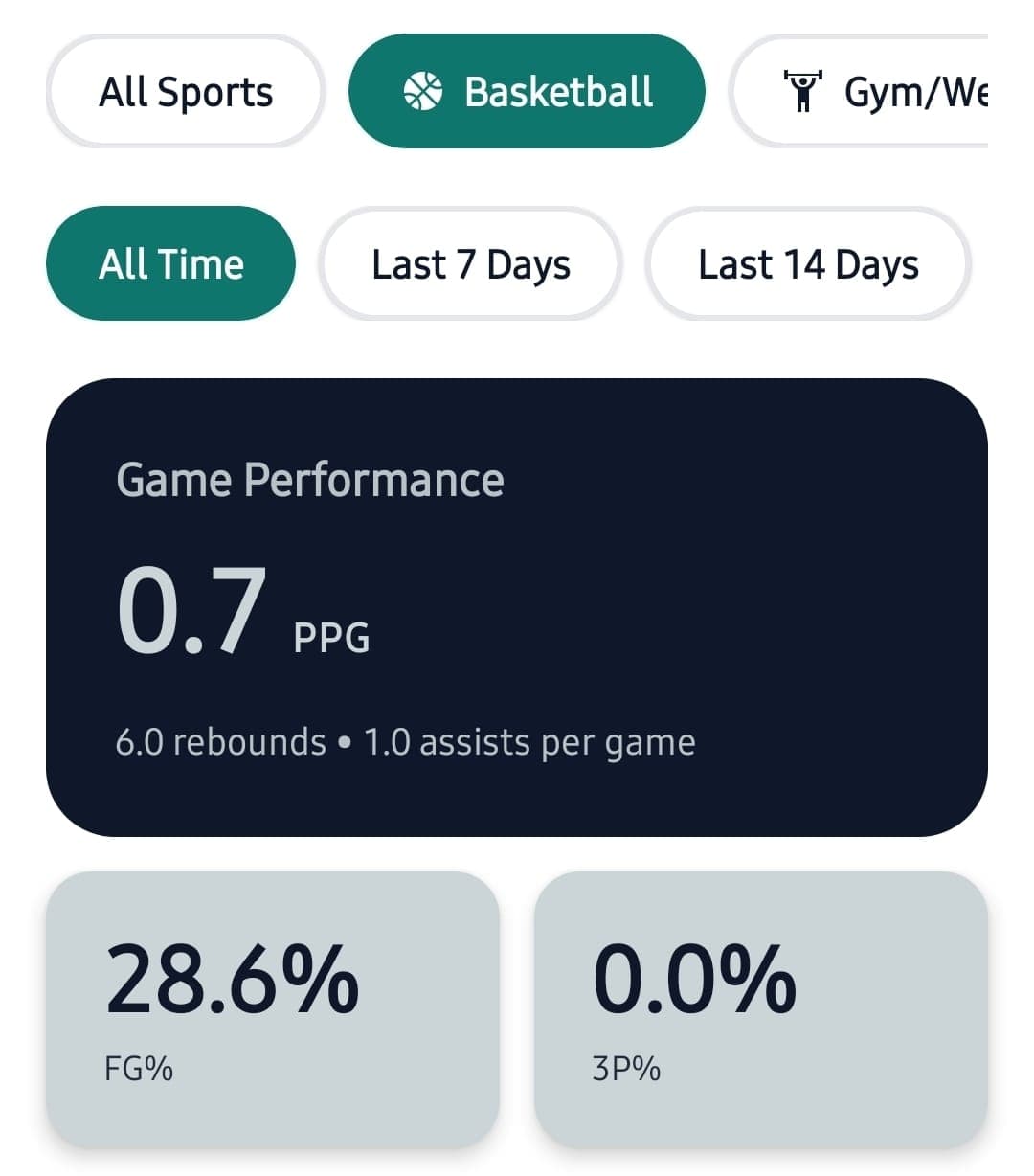
StatFlow is the solution to my first problem (inadequate tracking tools), built with the skills I learned from my data analysis experiments.
I knew exactly what information I wanted to see from my progress:
- Efficiency improvement across different time periods
- Spotting trends in my performance so I could maximize my limited skillset in games
- Continuing to track gym progress with visual trend lines showing improvement over time
I wanted to see it all in one place. No spreadsheets. No manual analysis. Just insights.
So I built it.
What I Learned Building It
This was a learning experience in every sense. StatFlow uses a relatively new tech stack for me, I'd only built one React Native app before, and I never shipped it. This was also my first time coding a backend. Mentors at university and knowledgeable people online guided me effectively, but there was a lot of trial and error.
Building the app was the easy part.
Distribution? That's the real challenge.
Getting through Google's closed testing requirements was brutal. My inner circle isn't huge, and the subset on Android is even smaller. I don't have the budget to push the app any way other than organically. I quickly learned how niche this community is, serious athletes who want deep analytics for their training aren't exactly a massive market.
But I love solo dev work.
It can be hard, lonely even, but tailoring something to exactly my vision has been my dream for the longest time. Every decision was mine. Every feature reflects what I wanted. There's something deeply fulfilling about that level of ownership.
And I had to ship when I did, or I never would.
I'm a perfectionist. Left to my own devices, I'd keep iterating forever, adding features, refining the UI, tweaking the analytics. But V1 needs to exist before V2 can. Shipping this, actually publishing it, making it available to the world, was necessary.
Having my first ever shipped project is the biggest thing StatFlow could do for me. I needed the confidence to know I can take an idea all the way to the end. Not just start projects and abandon them when they get hard or boring, but actually finish them.
That confidence is worth more than any download count.
What's Next
Immediate priorities:
I'll continue iterating based on user feedback. Fix bugs. Refine features. Get reviews. Build credibility.
The real marketing push starts in summer.
I turn 19 in May, which makes me eligible to publish on iOS. That's when I'll do the full marketing blitz, influencer outreach, proper launch announcements, the works. Until then, I'm focused on polishing the app and making it as good as possible so that when iOS launches, it's ready for a bigger audience.
Long-term, this is personal.
StatFlow is an app I use in my everyday life. I'm going to keep building it regardless of how many people download it. I'll add features users request. Maybe more sports. Possibly team creation and management. But most importantly, I'll make it useful enough that people actually stick around.
The Honest Reflection
I don't know if StatFlow will be a commercial success. I don't know if 100 people will download it or 10,000. I don't know if anyone will pay for premium, or if the freemium model even works.
But I know I built something real. Something I use daily. Something that solves a problem I had, and that other athletes probably have too.
Most importantly, I shipped it.
That's the thing I'm most proud of. Not the code. Not the features. Not even the idea itself. The fact that I took something from "wouldn't it be cool if..." to "here, download it on the Play Store."
Most people talk about building things. I actually built it and put it out there. That has to count for something.
Everything else, the downloads, the revenue, the metrics, that's all uncertain. But the fact that I shipped? That's certain.
And for today, that's enough.
StatFlow is available now on Google Play. iOS coming Summer 2026.
If you're interested in following the journey, what happens after launch day, how distribution works (or doesn't), what it's like building as a solo dev, I'll be sharing updates here.
Let's see what happens next.